
Technical Guide
Modular Building Compliance UK: Standards for Schools and Healthcare
BB93 acoustics. BB101 ventilation. HTM 03‑01 healthcare. Approved Documents B, L, M. The compliance anchors UK specifiers need — with ready‑to‑use copy‑paste templates for proposals and tenders.
Standards Covered
Education
BB93 & BB101
Healthcare
HTM 03‑01
Fire Safety
Approved Doc B
Energy
Approved Doc L
Accessibility
AD M & BS 8300
ISO 9001 Certified
15‑Year Structural Warranty
Constructionline Member
Copy‑Paste Templates Included
Education Sector
Education Compliance: BB93 Acoustics and BB101 Ventilation
Modular school buildings in the UK must meet two DfE Building Bulletins. Both are referenced in the Building Regulations and are effectively mandatory for state‑funded school projects. Getting these right in your specification avoids redesign, delays, and failed commissioning tests.
BB93 — DfE Building Bulletin 93: Acoustic Design of Schools
BB93 sets performance targets for:
- Indoor ambient noise level — typically stated as LAeq,30min for the specific room type.
- Reverberation time — typically stated as Tmf (mid‑frequency reverberation time) for the specific room type and size.
A common benchmark for primary teaching spaces (KS1/KS2 classrooms) is Tmf ≤ 0.6 seconds. However, BB93 contains detailed tables for different room types and sizes. Always use the correct table for your project.
Key Specification Note
BB93 acoustic testing is typically assessed in the finished, unfurnished‑for‑use condition. State this clearly in your specification to avoid disputes about test methodology.
For modular buildings, the critical design considerations are:
- Wall and roof panel acoustic performance (Rw values)
- HVAC noise contribution (often the dominant source in modular buildings)
- Flanking transmission at panel joints and service penetrations
- Floor impact sound (particularly in two‑storey modular configurations)
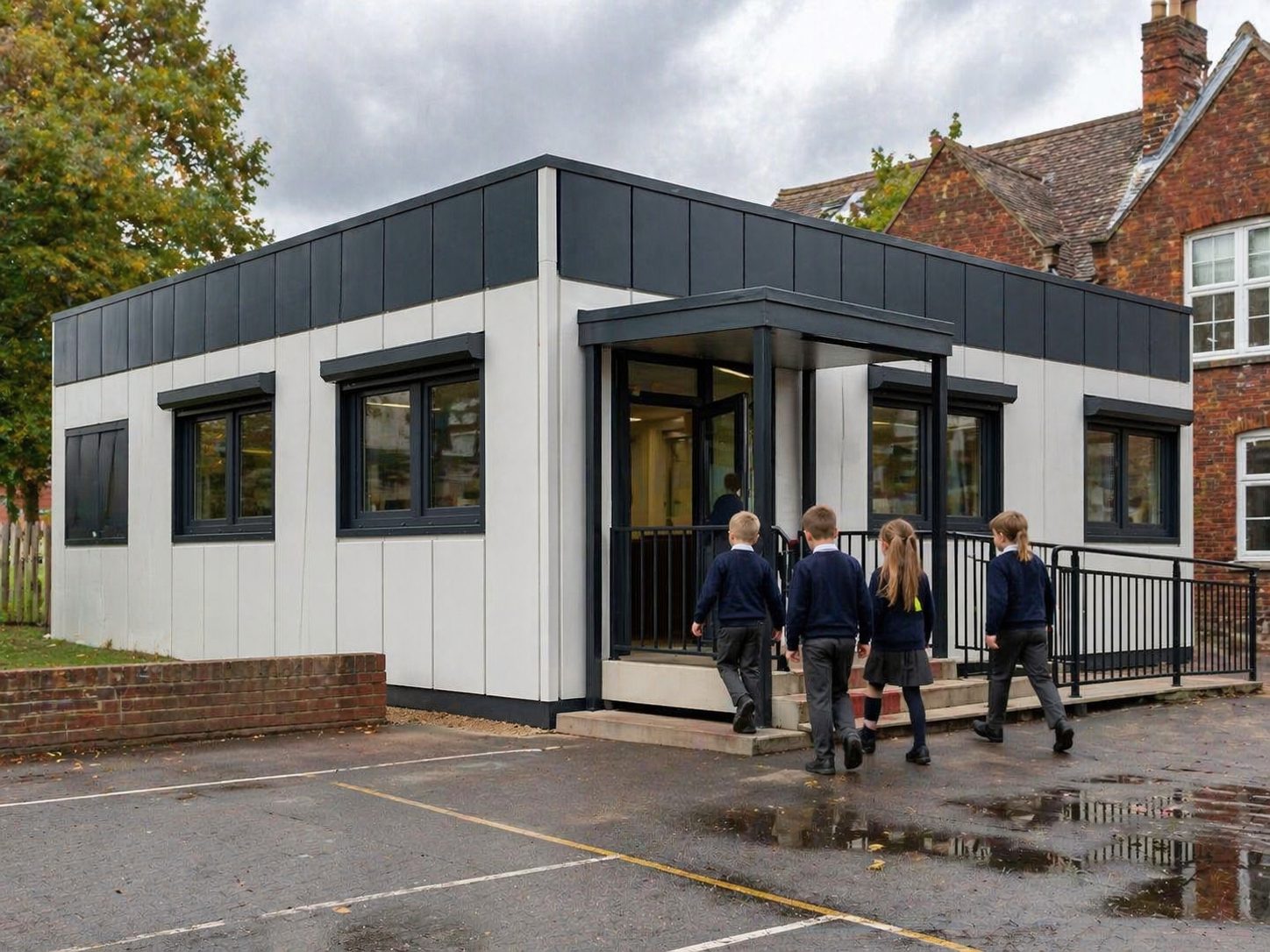
Modular classroom on a UK primary school site — designed to meet BB93 acoustic and BB101 ventilation standards
Healthcare Sector
Healthcare Compliance: HBN 00‑01 and HTM 03‑01 Ventilation
Modular healthcare buildings require specialised ventilation matched to clinical function. The two primary references are HBN 00‑01 (planning and design guidance) and HTM 03‑01 (specialised ventilation for healthcare premises).
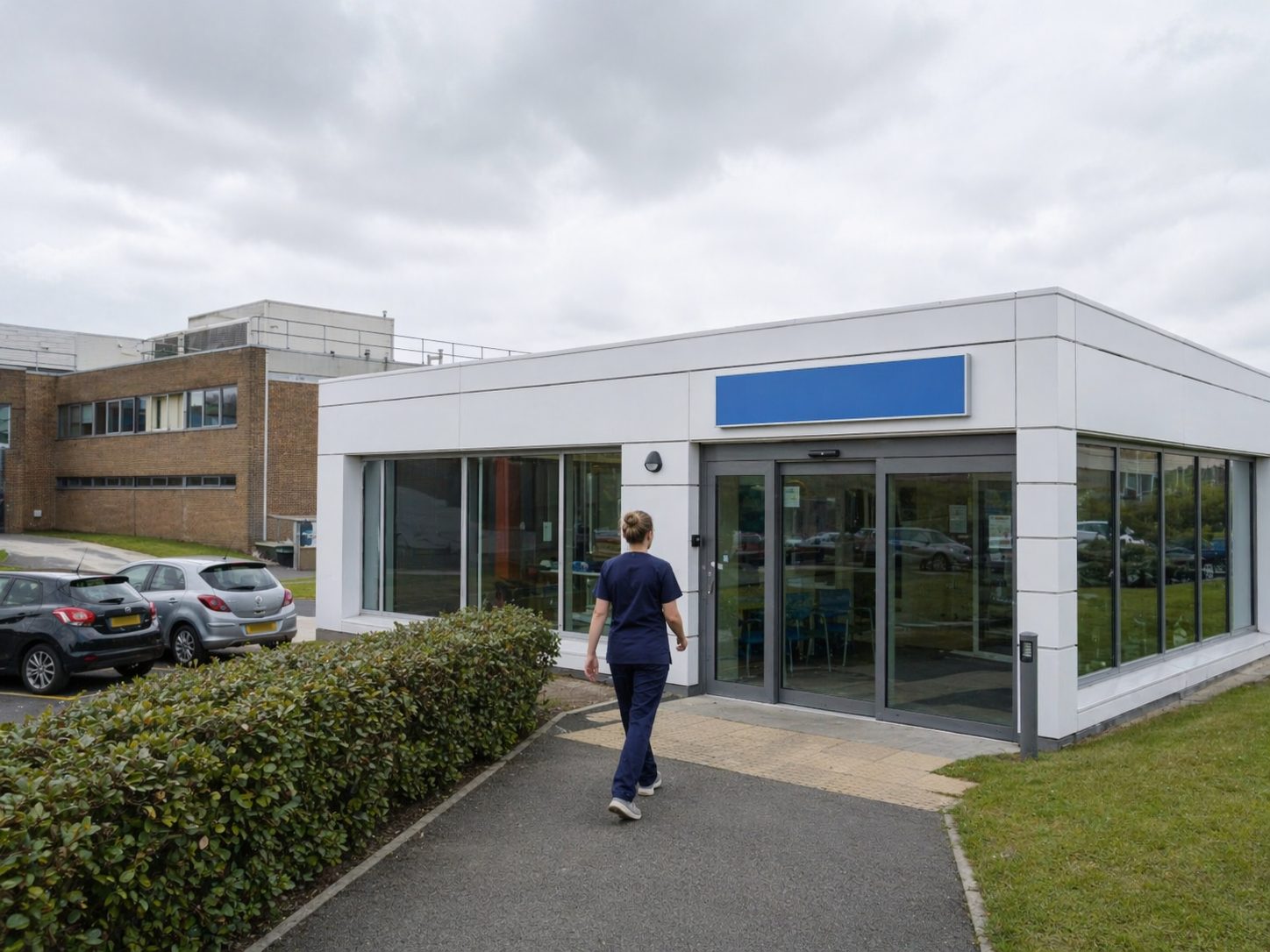
Modular clinical building on a UK hospital campus — designed to meet HTM 03‑01 specialised ventilation requirements
HTM 03‑01 — Specialised Ventilation for Healthcare Premises
Unlike education, where BB93 and BB101 cover most requirements, healthcare ventilation is highly variable by room type. Operating theatres, isolation rooms, consulting rooms, and waiting areas each have different requirements.
Your compliance anchor must define:
-
Air change rates (ACH) — matched to the clinical function of each room
-
Pressure regimes — positive pressure for clean rooms, negative pressure for isolation rooms
-
Filtration level — including HEPA filtration where required by the clinical brief
-
Commissioning and verification — acceptance testing at handover and periodic re‑validation schedule
Typical reference values often cited in healthcare specifications:
| Room Type | Typical ACH |
|---|---|
| Operating theatres | ~20–25 ACH |
| Airborne isolation rooms | ~10–12 ACH |
| Treatment / consulting rooms | ~6 ACH |
| Waiting areas | ~6 ACH |
Important: These are typical reference values. Always confirm project‑specific requirements with the clinical brief and the M&E designer. Healthcare ventilation design is not a one‑size‑fits‑all specification.
Building Regulations
UK Building Regulations: Core Compliance Anchors for Modular Buildings
Beyond sector‑specific standards, every modular building in the UK must comply with the Building Regulations. These four Approved Documents are the most relevant to modular building compliance UK specifications.
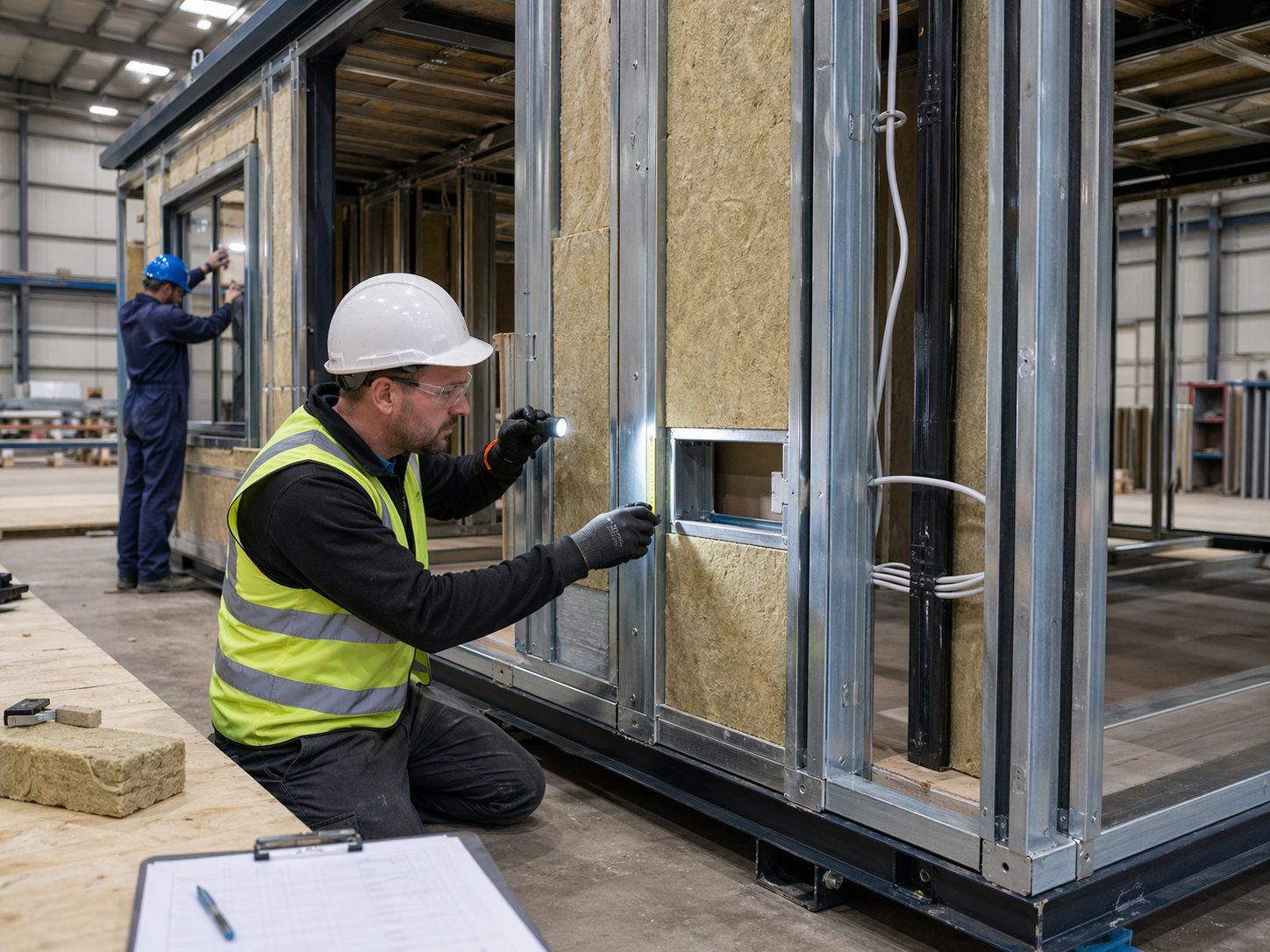
Approved Document B — Fire Safety
Your fire compliance anchor must state:
- Fire resistance periods (in minutes) for structural elements
- Compartmentation approach — how fire spread is contained
- External wall reaction‑to‑fire classification to BS EN 13501‑1
- Means of escape provisions
For modular buildings, pay particular attention to panel‑to‑panel joint fire integrity, service penetration fire stopping, and external cladding classification (particularly for buildings over 11m).
Tip: Always reference the latest online Approved Documents at the time of procurement. AD B is updated periodically.
Approved Document L — Energy Performance
Your energy compliance anchor must state:
- The compliance route (SAP for dwellings, SBEM for non‑domestic, or dynamic simulation)
- Target metrics — primary energy rate and CO₂ emission rate vs. the Target Emission Rate (TER)
- The U‑values used in the compliance model
KC Performance: U‑values of 0.16–0.18 W/m²K for walls, 0.11 W/m²K for roofs and floors, and 0.5–0.7 W/m²K for triple‑glazed windows — comfortably exceeding Part L 2021 requirements.
Approved Document M — Accessibility (+ BS 8300)
Your accessibility compliance anchor must confirm:
- Step‑free approach routes to all principal entrances
- Accessible WC provision (dimensions, transfer space, fittings)
- Key clearances — door widths, corridor widths, turning circles
- Control heights — switches, sockets, door handles within accessible reach range
Modular advantage: Accessibility is designed into the factory layout — not value‑engineered out during the build.
Eurocodes EN 1990–1999 — Structural Design
Your structural compliance anchor must state:
- Design basis to Eurocodes (EN 1990 for basis, EN 1991 for actions, EN 1993 for steel, EN 1995 for timber)
- Ultimate Limit State (ULS) and Serviceability Limit State (SLS) approach
- Serviceability criteria — deflection limits are project‑specific and must come from the structural engineer
KC approach: Volumetric modular systems with steel and timber frames designed to Eurocodes. All structural calculations by chartered engineers.
Quick Reference
Modular Building Compliance Checklist

Education & Fire Safety
- Part L 2021 energy compliance confirmed
- Fire strategy reviewed (EI 30–45, FD30/FD60)
- BB93 / BB100 acoustic requirements addressed
- Fire alarm integration specified
- Means of escape documented
Healthcare & Hygiene
- FIBO wall panels for wet rooms specified
- GEBERIT sanitary systems confirmed
- Acoustic separation between clinical spaces
- DDA / Part M accessibility designed in
- Infection control surfaces where required
Building Regulations
- Part A — structural design signed off
- Part B — fire safety strategy complete
- Part E — acoustic performance specified
- Part F — ventilation design confirmed
- Part M — accessibility compliance checked
Procurement & Documentation
- UKCA / CE marking confirmed for all products
- Declaration of Performance (DoP) received
- Importer/distributor obligations documented
- Evidence pack included in submittals
- Scope boundary statement in quotation