Modular Padel Club Reception Buildings (UK): Best Practices, Costs & Spec Checklist (2026)
The complete guide to planning, specifying, and building a high-quality modular reception building for your padel club — fast, compliant, and built to impress.
- Speed advantage: Factory-built modular units install in weeks, not months — ideal for clubs already operating courts
- Revenue-focused design: Best clubs design the "money path" — reception → pro shop → café → courts
- Compliance matters: Planning permission usually required; Building Regulations (Part L, Part M, fire) apply to modular buildings
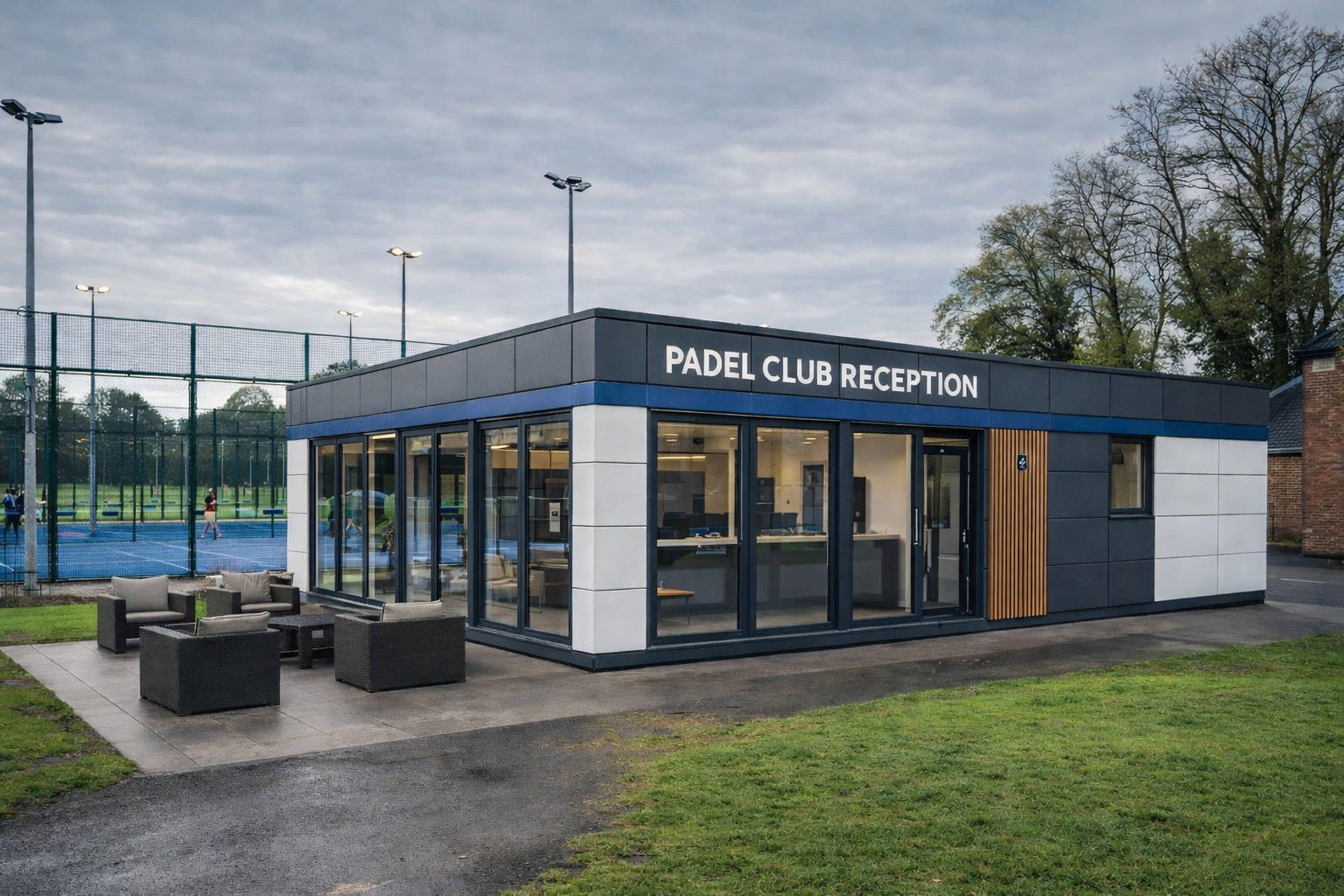
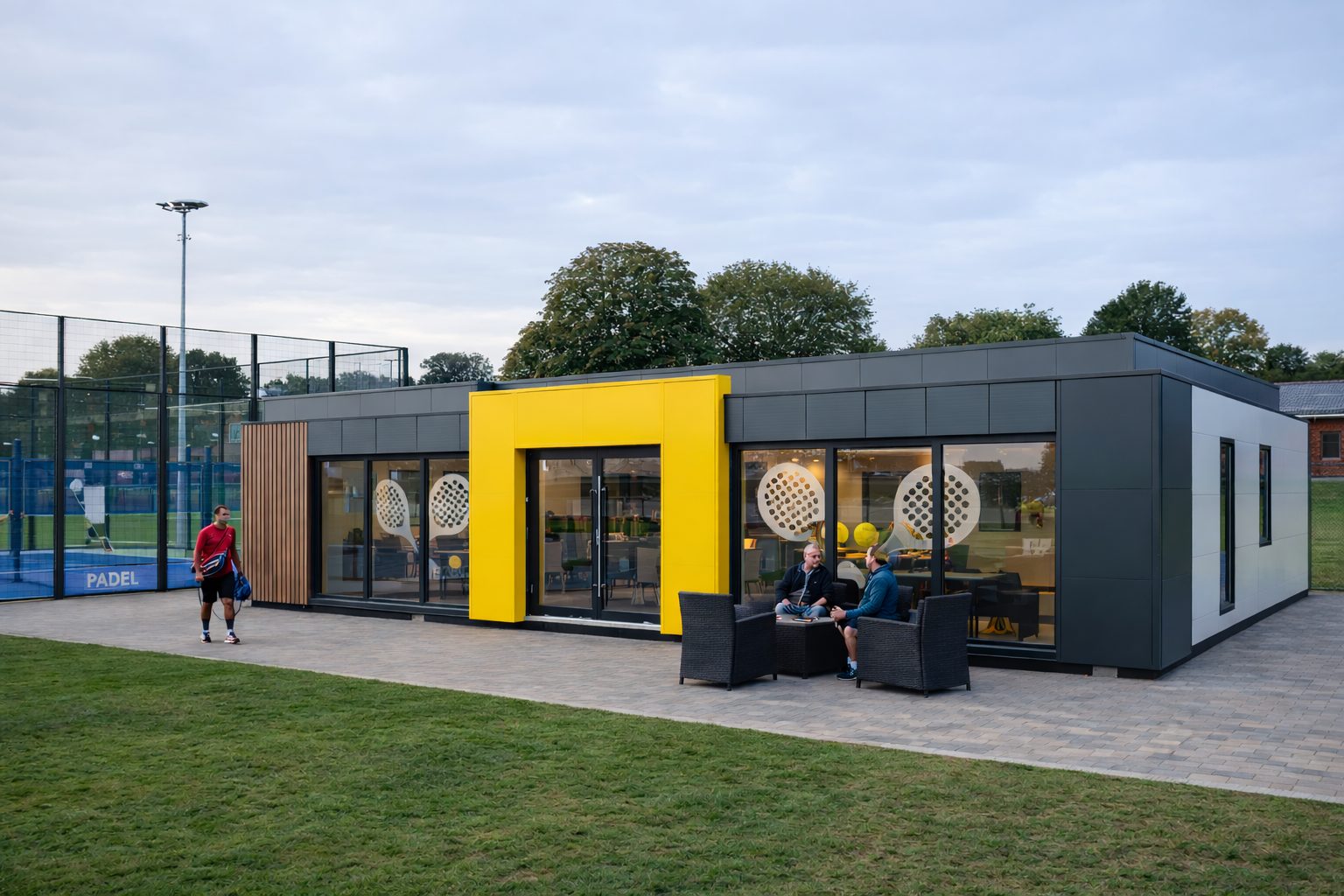
- Premium finish is achievable: Aluminium glazing, composite cladding, flat roofs — modular can look as good as traditional build
- Future-proof: Plan expansion points now — café extension, rooftop terrace, extra WCs, changing rooms
- Don't undersize: The biggest mistake clubs make is building too small for peak times, leagues, and events
Padel is booming — and the clubs that win aren't just adding courts. They're building a proper front-of-house experience: reception, pro shop, café, WCs, staff space, storage, and a warm place for members to spend money (and time) before and after games.
If you're planning a new site or upgrading an existing venue, a modular padel club reception building is usually the fastest way to get a high-quality, compliant facility on the ground — without months of wet trades and disruption.
This guide covers the best practices, the common questions, and a spec checklist you can use to compare suppliers.
Why Modular Works So Well for Padel Reception Buildings
A reception building for a padel club is a commercial unit with a few non-negotiables: it must look premium, cope with heavy footfall, stay warm, and be ready fast.
Modular construction is a strong fit because it gives you:
- Speed: Factory build + rapid installation (often weeks, not months)
- Predictable costs: Fewer surprises than traditional builds
- Minimal disruption: Ideal when you're already operating courts
- A premium finish: Aluminium glazing, composite cladding, modern flat roofs
- Future flexibility: Expand later (add café seating, terrace, extra WCs, pro shop)
Best Practices: What the Best Padel Clubs Do
1) Design the "Money Path" First
Reception isn't just a desk — it's your conversion engine. The best padel clubs design their building around the customer journey, maximising dwell time and spend.
Best practice layout zones:
Arrival + Check-in
Clear sightline to courts. First impression matters.
Retail / Pro Shop
Impulse buys: grips, balls, apparel, accessories.
Waiting / Lounge
Keeps people on site before and after games.
Café / Servery
Highest-margin add-on for many clubs.
WCs + Accessible WC
Don't bury these at the back — easy access is key.
Staff / Store
Stock, cleaning, IT, first aid — out of sight but accessible.
Pro Tip: Café Service Hatch
If you're adding a café, consider a separate service hatch for busy periods and events. It speeds up service and reduces congestion inside.
2) Make Glazing Do the Marketing
Padel is visual. Clubs that grow fastest make the building part of the brand.
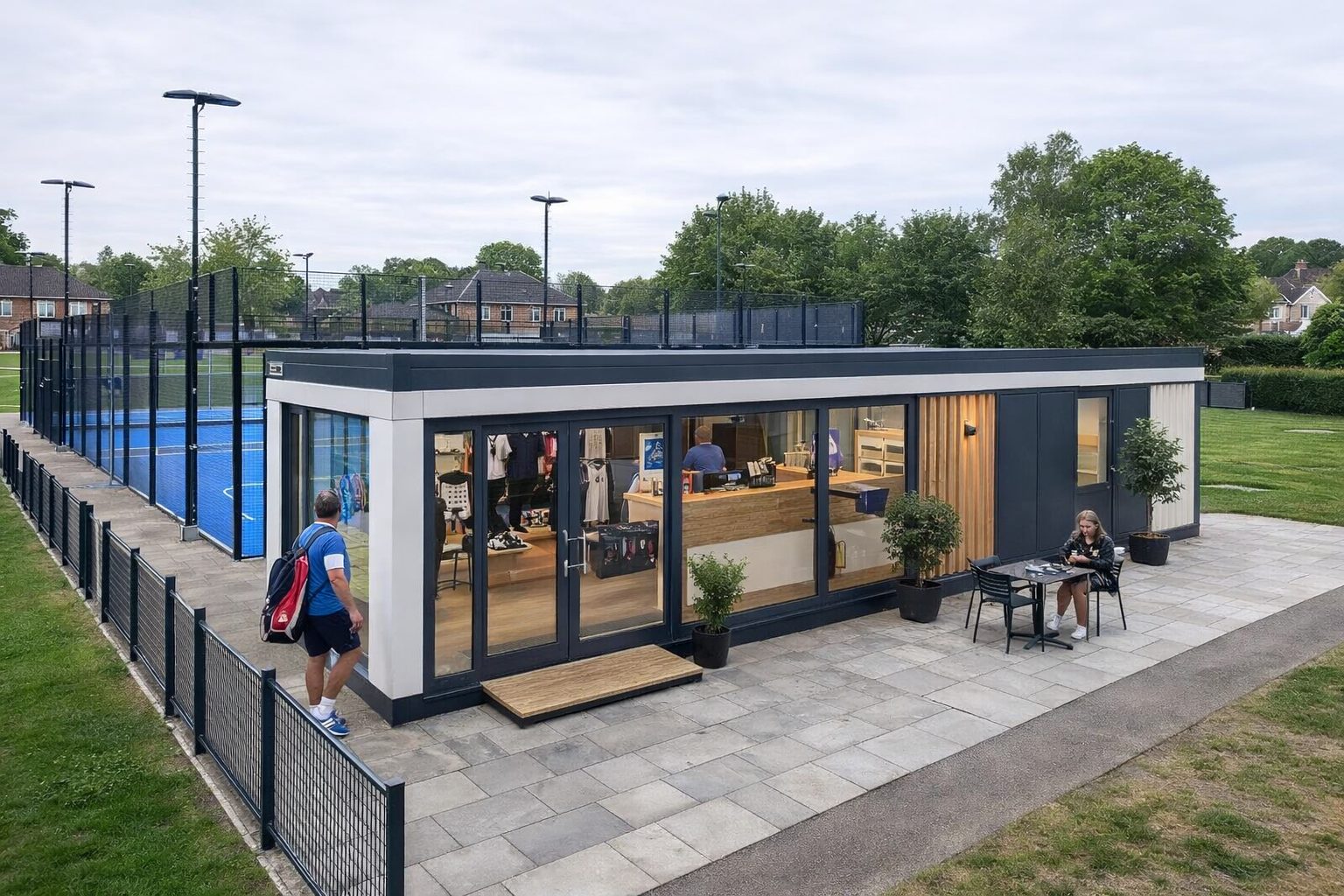
- Use aluminium-framed glazing to create a premium, modern frontage
- Add signage zones (fascia band, entrance portal, window graphics)
- Keep the entrance obvious — members shouldn't "hunt" for reception
- Consider views to courts from the lounge/café area
3) Specify the Building Envelope for Comfort (and Bills)
Reception buildings run all day, every day. Good insulation + airtightness isn't a "nice to have" — it protects your operating costs.
Look for:
- Part L 2021-ready performance (or better)
- High-performance insulated wall/roof panels (target U-values around 0.18 W/m²K walls, 0.11 W/m²K roof)
- Proper detailing to avoid cold bridges and condensation
- Quality windows and doors with thermal breaks
- Airtightness testing to verify performance
4) Plan Compliance Early (It Saves Weeks)
Common delays come from leaving compliance until late. Get ahead of these from day one:
- Planning permission — often required for new buildings
- Building Regulations — energy, fire, accessibility, electrics
- Accessibility (Part M) — step-free access, door widths, accessible WC
- Fire strategy — fire doors, escape routes, fire-rated options where needed
- Drainage and utilities — connections for water, waste, electric
Don't Assume Permitted Development
Some sites may have permitted development rights, but it's highly site-specific. Always check with your local planning authority or planning consultant before committing to a build programme.
5) Build for UK Weather and UK Footfall
Padel clubs are high-traffic environments. Specify materials that can handle the punishment:
- Commercial-grade flooring — easy-clean, hard-wearing (SPC vinyl or similar)
- Durable cladding with low maintenance requirements
- Proper roof membrane detailing and drainage falls
- Acoustic separation where you need privacy (office/meeting room)
- Robust entrance matting to protect interior floors
6) Future-Proof with Modular Expansion Points
Even if you start with a compact reception, plan for growth:
Café Extension
Add covered outdoor seating or expand the servery later.
Changing Rooms
Add dedicated changing facilities as membership grows.
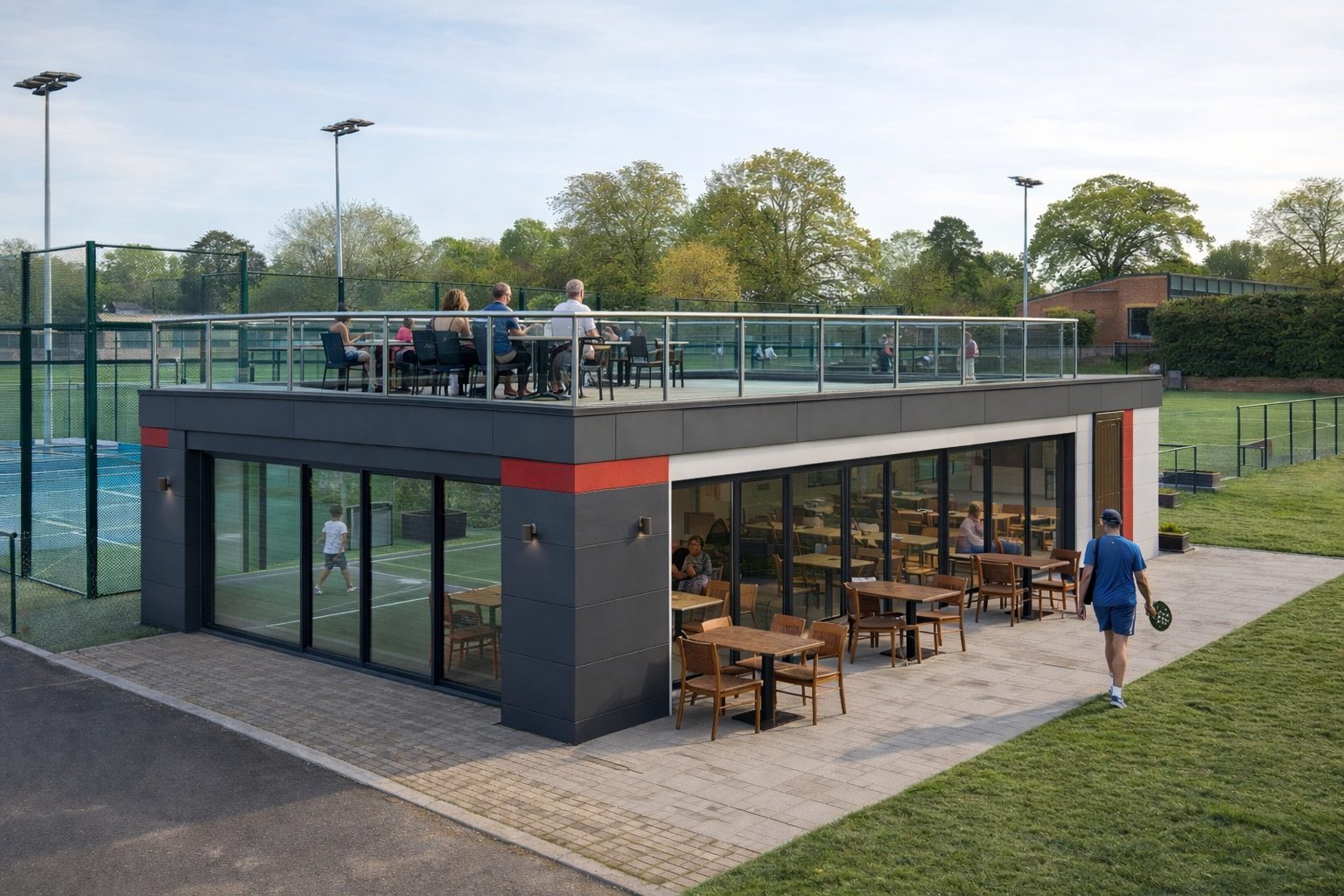
Rooftop Terrace
Where planning allows — great for events and summer trade.
Event Storage
Extra storage for leagues, tournaments, and coaching programmes.
Common Questions (Straight Answers)
Do modular padel reception buildings need planning permission in the UK?
In most cases, yes — especially for a new standalone building. Some sites may have permitted development rights, but it's highly site-specific.
Always check with your local planning authority or a planning consultant before committing to a build programme. We can help you navigate this process.
Do modular buildings have to meet Building Regulations?
Yes. In the UK, modular buildings are still buildings — they must meet the relevant Building Regulations, including:
• Part L — Energy performance (conservation of fuel and power)
• Part B — Fire safety
• Part M — Accessibility
• Part P — Electrical safety
A reputable modular supplier will design and build to meet these requirements and provide the necessary documentation.
How long does a modular padel reception building take?
It depends on size and specification, but the big advantage is that most of the work happens in the factory.
Typical timelines:
• Design and approvals: 4–8 weeks (depending on planning)
• Factory manufacture: 6–12 weeks
• Site installation: 1–2 weeks (once foundations/services are ready)
Compare that to 4–6+ months for a traditional build with wet trades.
What should be included in a padel reception building?
At minimum:
• Reception / check-in area
• Staff / store room
• WCs (including accessible WC)
Most clubs that maximise revenue add:
• Café / servery
• Lounge seating area
• Pro shop / retail
• Office / coaching room
What's the biggest mistake padel clubs make?
Undersizing the building.
If you're investing in courts, don't bottleneck the business with a tiny reception that can't handle peak times, leagues, and events.
Think about:
• How many people will be waiting between games?
• Do you want to host tournaments and social events?
• Will you run coaching programmes that need space?
• Is there room for the café/retail to actually generate revenue?
It's almost always cheaper to build slightly bigger upfront than to extend later.
How much does a modular padel reception building cost?
Costs vary significantly based on size, specification, and site conditions. As a rough guide:
• Basic reception + WCs (30–40m²): £45,000 – £70,000
• Reception + café + WCs (60–80m²): £80,000 – £130,000
• Full clubhouse with pro shop, café, office (100–150m²): £140,000 – £220,000+
These are indicative figures for the building only. Site works, foundations, and utility connections are additional.
Contact us for a detailed quote based on your specific requirements.
Can you install a modular building while the courts are in use?
Yes — this is one of the key advantages of modular construction.
Because 90% of the build happens off-site in a factory, on-site disruption is minimal. Installation typically takes just 1–2 weeks, and we can schedule deliveries and crane lifts to minimise impact on your operations.
Spec Checklist: What to Ask Your Modular Supplier
Use this as a quick comparison list when evaluating modular building suppliers for your padel club reception.
| Category | What to Look For | KC Modular Spec |
|---|---|---|
| 🛠 Structure | ||
| Frame type | Steel structural frame with anti-corrosion protection | ✓ Hot-dip galvanised steel |
| Design life | Designed for long-term durability (50+ years) | ✓ 50–60 year lifespan |
| Precision | Factory-built for precise alignment and fit | ✓ ISO 9001 certified manufacture |
| 🌡 Thermal + Envelope | ||
| Wall U-value | Target around 0.18 W/m²K or better | ✓ 0.16–0.18 W/m²K |
| Roof U-value | Target around 0.11 W/m²K or better | ✓ 0.11 W/m²K |
| Compliance | Part L 2021 alignment | ✓ Exceeds Part L 2021 |
| Insulation | High-performance panels (Kingspan or equivalent) | ✓ KINGSPAN QuadCore |
| Airtightness | Tested and certified airtightness | ✓ 1.57 m³/(h.m²) tested |
| 🚧 Windows & Doors | ||
| Glazing | Double or triple glazed with thermal breaks | ✓ Triple-glazed (U=0.7 W/m²K) |
| Frames | Aluminium or high-quality uPVC | ✓ Aluminium with thermal break |
| Entrance doors | Commercial-grade, accessible width (min 900mm clear) | ✓ 1.1 W/m²K, DDA compliant |
| Fire doors | FD30 minimum where required | ✓ FD30/FD60 available |
| 🌡 Heating & Ventilation | ||
| Heating system | Energy-efficient (heat pump preferred) | ✓ Air-air heat pump (SCOP 4.5) |
| Ventilation | Adequate fresh air provision | ✓ Natural + mechanical options |
| MVHR option | Heat recovery ventilation available | ✓ MVHR upgrade available |
| ⚡ Electrical | ||
| Compliance | BS 7671 18th Edition | ✓ Full compliance |
| Lighting | LED throughout, emergency lighting | ✓ IP65 LED + emergency |
| Consumer unit | RCD protection, adequate circuits | ✓ RCD protected |
| Data/comms | Provision for broadband, EPOS, CCTV | ✓ Cat6 ready |
| 🚽 Sanitary | ||
| WC provision | Adequate for expected footfall | ✓ Bespoke to requirements |
| Accessible WC | Part M compliant, Doc M pack | ✓ Full Doc M compliance |
| Fittings | Commercial-grade, durable | ✓ Geberit systems |
| Hot water | Adequate capacity for peak demand | ✓ 80L+ water heater |
| 🎨 Finishes | ||
| Flooring | Commercial-grade, easy-clean | ✓ SPC vinyl (waterproof) |
| Walls | Wipe-clean, durable finish | ✓ Factory-finished panels |
| Cladding | Low-maintenance, weather-resistant | ✓ Composite / steel options |
| Colours | Choice of RAL colours | ✓ Full RAL range |
| 📋 Compliance & Certification | ||
| ISO certification | Quality management system | ✓ ISO 9001, 14001 |
| Steel certification | Structural steel quality | ✓ ISO 1090, 3834 |
| H&S accreditation | SSIP or equivalent | ✓ Acclaim, SSIP, Constructionline |
| Warranty | Structural and defects warranty | ✓ 15-year structural, 24-month defects |
Download This Checklist
Want a printable version? Contact us and we'll send you a PDF spec checklist you can use when comparing suppliers.
KC Modular Buildings — By the Numbers
Ready to Plan Your Padel Club Reception Building?
Whether you're at concept stage or ready to build, we can help you design a modular reception building that works for your site, your budget, and your growth plans.
- Free initial consultation and site review
- Bespoke design to match your brand and layout
- Full compliance support (planning, Building Regs, accessibility)
- Factory manufacture with rapid site installation
- Flexible payment terms and asset finance available
KC Modular Buildings
We design, manufacture, and install bespoke modular buildings for commercial, education, healthcare, and leisure clients across the UK. With ISO 9001 certified production and over 15 years of experience, we deliver buildings that perform — on time and on budget.
Related Articles
Bespoke Modular Buildings
Custom-designed modular buildings for commercial, education, and healthcare.
Technical Specifications
Detailed specs, U-values, and compliance information for all product lines.
Sports Pavilions & Clubhouses
Modular changing rooms, clubhouses, and pavilions for sports clubs.